If you’re planning a trip to Italy and will be stopping in Florence, be sure not to miss these incredible sculptures created by Michelangelo for an unfinished monument known as the ‘Prisoners’.
The unfinished sculptures known as the ‘Prisoners’ or ‘Slaves’, created by Michelangelo, were intended to form part of the funerary monument commissioned by Pope Julius II in 1505. This monument was to be placed inside St Peter’s Basilica in Rome.
According to the original design, the monument was to consist of a multi-level architectural structure featuring about 40 sculptures depicting allegories of prisoners, prophets and sibyls, as specified in the contract signed by the artist.
Following various developments, the design of the funerary monument was significantly scaled down to include only six statues sculpted by Michelangelo himself, and that it should be located in the Basilica of St. Peter in Chains instead of St. Peter’s Basilica. Julius II had been the titular patron of the Basilica of St. Peter in Chains before becoming pope.
The funerary monument for Julius II would not be completed until 1545, many years later. The famous Moses is the only original sculpture to be placed in the tomb.
Join us on a walking tour of the Monti neighborhood to visit the Church of San Pietro in Vincoli and admire the statue of Moses and the monument’s final version.
Michelangelo’s Prisoners: The Spirit’s Struggle to Break Free from Matter
The statues of prisoners were intended to evoke those depicted in Roman triumphal monuments as the emperor’s spoils of war. They were to be placed on the first tier of the tomb.
The Prisoners of the Louvre: Tension and Poignant Beauty
In 1514, he sculpted two figures from the Prisoners series, which are now housed at the Louvre in Paris. Michelangelo gave them to Roberto Strozzi as a token of gratitude for helping him through two serious illnesses. Later, while in exile in Lyon, he gave them to the King of France.
The two sculptures at the Louvre, known as The Dying Slave and The Rebellious Slave, are both classically inspired.
The Rebellious Prisoner‘s body twists in a desperate struggle, his muscles straining as he tries to free himself from the chains symbolising spiritual bondage.The influence of the Laocoön group—a famous example of Hellenistic art discovered in Rome during those very years—is evident.
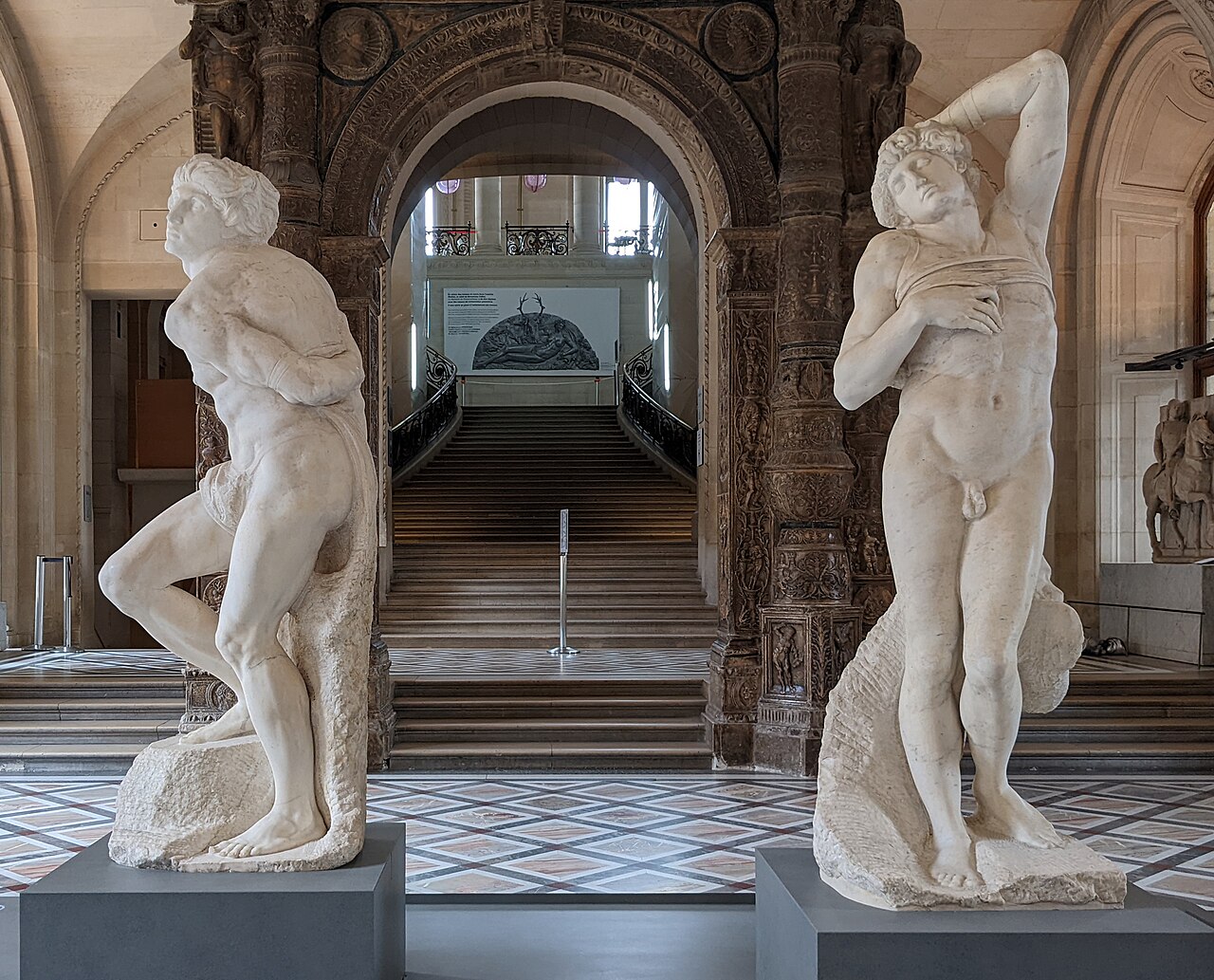
The Dying Prisoner reveals the heart-wrenching desolation of a body and soul ravaged by pain. This is not just physical pain, but an inner torment that only finds peace in sleep or death.
The Academy’s Prisoners: Figures Trapped in Marble
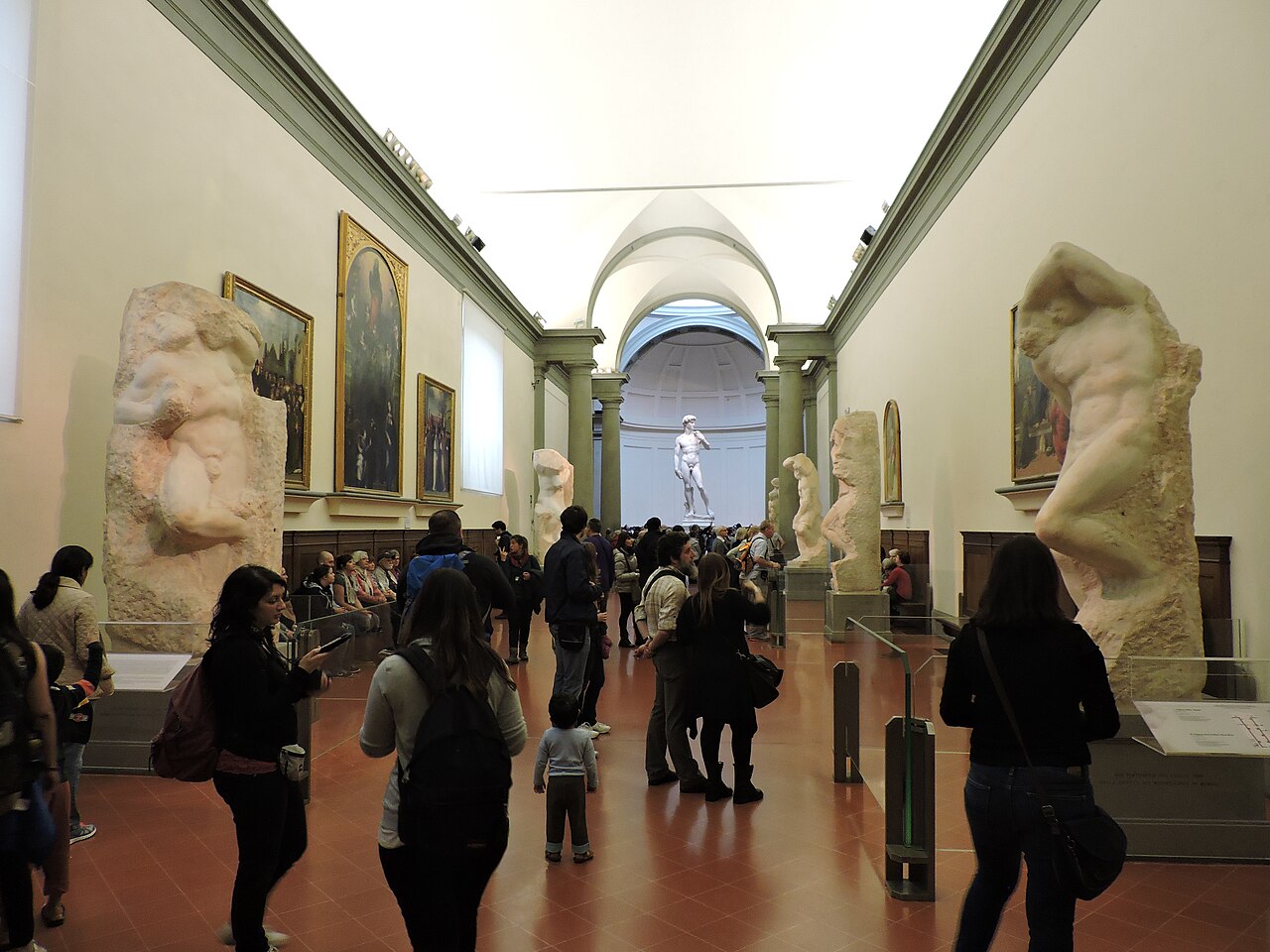
Following the events of 1521, Michelangelo began sculpting two new statues for the tomb of Julius II in Florence: the Prigioni, which are now housed at the Accademia in Florence. Unlike the Prigioni sculpted in Rome, these convey a more anguished passion, reflecting the artist’s state of mind during those years.
The artist intentionally left these figures unfinished, giving the impression that they are struggling to emerge from the stone, as if they are imprisoned within the material itself. This unfinished state exudes incredible charm, aligning closely with modern aesthetics while allowing us to fully appreciate Michelangelo’s unique sculpting technique.
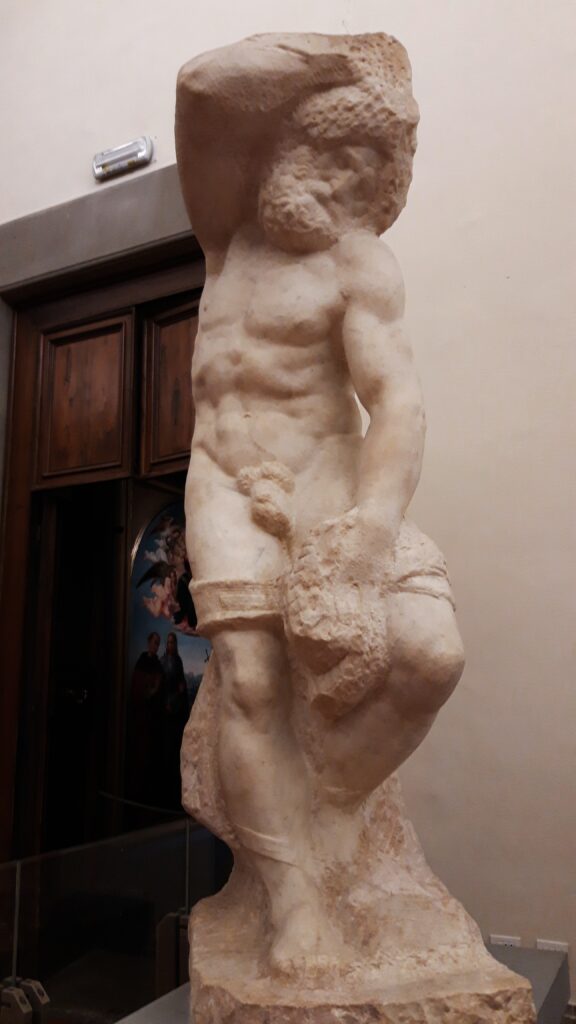
In the sculpture known as the ‘Bearded Slave‘, Michelangelo intended to portray the subject as a powerful warrior who is overwhelmed by life. We can admire the indomitable strength with which he resists his fate.
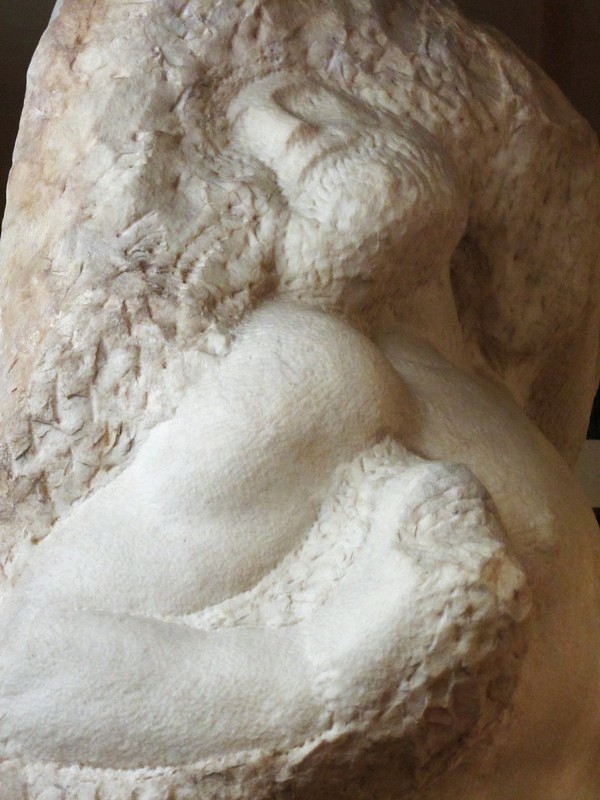
In The Awakening Slave, the body twists as it struggles to emerge into the light. The face and limbs remain trapped within the rock. The muscular strength of the torso and the movement of the right leg convey the effort being made to break free.
The sculpture, known as The Young Man, is still unfinished on the back. The face is obscured by the left arm and, due to the position of his legs, it seems as though he is trying to free himself from an invisible restraint. His left arm is pinned behind his back.
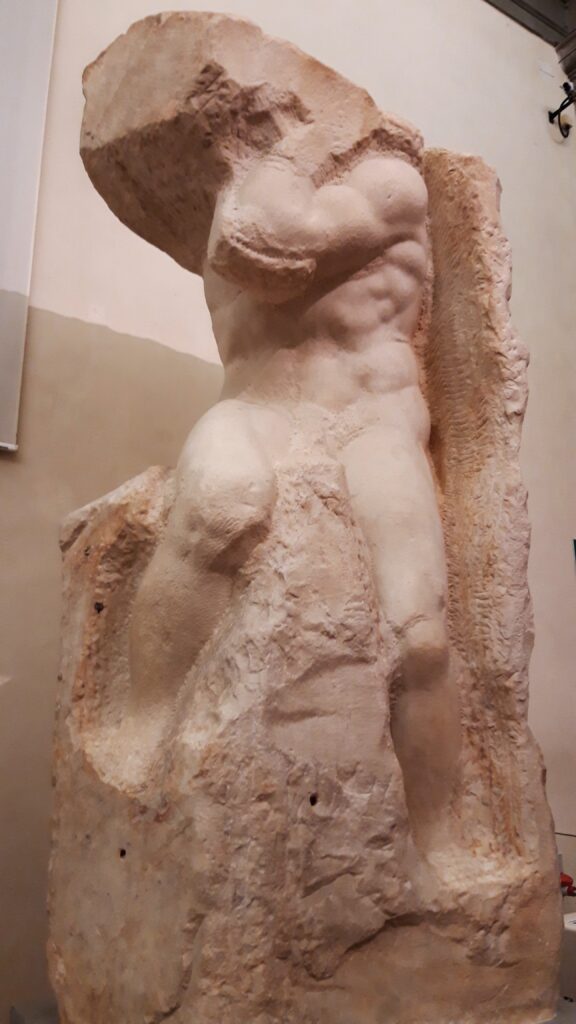
The most dramatic sculpture is known as Atlas: the torso and left arm are almost complete, while the head, back and right arm are still encased within the roughly hewn block. The head appears to weigh upon him as the sky does upon the shoulders of the mythical Titan Atlas. The conflict between form and matter is at its most intense.
Michelangelo’s concept of the unfinished
In these sculptures, Michelangelo developed an innovative marble-carving technique: he carved certain parts of the block to perfection, leaving others still enclosed within the rough-hewn mass as it had been extracted from the quarry. This technique was extremely risky, as there might not be enough space left to carve the rest of the figure once certain parts had been carved.
This could never have happened to Michelangelo. He was so adept at perceiving the space still trapped within the stone that he could start from the surface and volume alone to understand where the rest of the sculpture lay.
The form is already present in the marble and the sculptor’s task is to free it by removing the excess. As Michelangelo writes in his sonnets, the ‘great artist’ must simply reveal what already exists in the material. This technical skill enabled him to adapt the figures as he worked, adjusting them to take into account the new possibilities created by the parts he had already carved.
Michelangelo developed a new language through his unfinished works; his sculptures are visions to be interpreted, vibrant and suspended between what has been said and what remains unspoken.