WHAT IS THE JUBILEE?
The Jubilee, also known as the Holy Year, is a special year dedicated to reconciliation, conversion and spiritual renewal, which offers the faithful the opportunity to receive plenary indulgence.
ORIGINS OF THE JUBILEE
IN THE TORAH
The origin of the Christian Jubilee is to be found in Leviticus, one of the oldest books of the Hebrew Bible, in which it is established that a Sabbatical year is lived every seven years and a Jubilee Year every seven weeks of years, i.e. every forty-nine years. On this occasion each Israelite returned to possess the land of his fathers, and equality was restored to all the children of Israel. It was therefore a year to remedy the social imbalance caused by the distribution of land and the inequality of classes. It was a year for restoring social justice.
ORIGIN OF THE WORD JUBILEE
The announcement of the fiftieth year was given by the priests by blowing into the empty horn of the ram, “Jobel”, in Hebrew, from which the name “Jubilee” originated. Another thesis derives Jubilee from the verb “Hobil” which means to bring back or recall, due to the fact that during the Jubilee year slaves were freed, current debts were remitted and land assets were returned to the original master.
IN THE BIBLE
In the New Testament the Jubilee finds its continuation although with a new value, essentially spiritual and religious compared to the legal and social one of the Jewish Jubilee. The Christian Jubilee frees slaves from sins and they return to spiritual freedom. It is intended as “a year of grace”, a year of remission of sins, of reconciliation with God, a year of hope and salvation.
This is linked to the Church’s ability to dispense indulgences attributed to it according to the Gospel of Matthew
« To you I will give the keys of the kingdom of heaven, and whatever you bind on earth will be bound in heaven, and whatever you loose on earth will be loosed in heaven. »
(Matthew 16.19)
THE FIRST JUBILEE IN HISTORY
In 1300, Boniface VIII announced the first Jubilee, also known as the “Holy Year”, which fell every 100 years, therefore it was secular and was not called the Jubilee but the “hundred-year indulgence”, it did not include rites for the opening of holy doors.
This extraordinary event would have a lasting impact on the history of Christianity. It strengthened the spirituality of the faithful and consolidated papal authority by increasing the centrality of Rome as a pilgrimage destination.
In the bull “Antiquorum habet fida relatio“, Pope Boniface VIII proclaimed the Holy Year in 1300, establishing that anyone who made a pilgrimage to Rome and visited the basilicas of St. Peter and St. Paul would obtain a plenary indulgence, a remission of all temporal punishments for sins already confessed. This indulgence had never before been granted on such a large scale and represented a great attraction for the faithful who flocked to Rome in extraordinary numbers.
The frequency varies over time: it was reduced to 50 years in 1343 by Clement VI to allow each generation to have one and to 25 in 1470 by Paul II.
There are also ‘extraordinary’ moments: for example, in 1933 Pius XI wanted to commemorate the anniversary of the Redemption and in 2015 Pope Francis proclaimed the Year of Mercy.
PILGRIMAGE
Pilgrimage is a thousand-year-old and universal practice present in many cultures and religions, but it has a unique and profound meaning in the Christian tradition.
In the context of the Catholic faith, pilgrimage represents the soul’s journey towards God, a journey of research and encounter with the divine that passes through physical and at the same time symbolic places.
ORIGINS OF THE CHRISTIAN PILGRIMAGE
The origins of Christian pilgrimage date back to the first centuries AD, when the faithful began to visit places linked to the life, passion and resurrection of Jesus.
Jerusalem, considered the holy city par excellence, became one of the first and most important pilgrimage destinations, together with Rome, where the tombs of the apostles Peter and Paul are located.
As the centuries passed, other destinations were added such as Santiago de Compostela in Spain, the burial place of the apostle James, and many Marian sanctuaries throughout Europe and the world.
The Jubilee invites all Christians to rediscover pilgrimage as a journey of faith, reflection and interior conversion. Each stage of the pilgrimage is a symbolic step towards purification and spiritual rebirth.
Crossing the Holy Door, performing penance, praying and reflecting along the way symbolize the desire for change and spiritual growth.
In addition to Rome and Jerusalem, there are numerous famous sanctuaries and pilgrimage sites in the Christian world.
Santiago de Compostela, where thousands of pilgrims go every year along the “Way of Santiago”, one of the most well-known and evocative routes.
Lourdes in France, Fatima in Portugal and Czestochowa in Poland are Marian shrines that attract millions of faithful, especially those seeking healing and spiritual comfort.
BULL OF INDICTION
The Jubilee is proclaimed through an official document, the Papal Bull or Bull of Indiction with which the pontiff announces the celebration of a Holy Year. It is generally written in Latin, with the seal of the Pope, the form of which gives its name to the document itself. Each Bull is identified by its initial words. The Bull is registered, published and posted in the Basilicas of Rome.
It indicates the dates of the beginning and end of the Holy Year, it is usually issued the previous year, coinciding with the Solemnity of the Ascension. For the Jubilee of 2025, the Holy Father, Pope Francis, read the bull Spes non confundit, “Hope does not disappoint” during the delivery ceremony in the atrium of St. Peter’s Basilica in the Vatican, on May 9, 2024. The theme of this Jubilee is Hope.
Read the full text of the Papal Bull SPES NON CONFUNDIT here.
HOW IS PLENARY INDULGENCE OBTAINED
By participating in the Holy Year you experience plenary indulgence, to acquire it you need to:
- be baptized
- not be excommunicated
- be in the confessed and communicated state of grace
- perform works of mercy or penance
- visit the four Major Basilicas
- pray according to the intentions of the Holy Father
Read here the rules on the granting of Indulgence in the Jubilee Year 2025.
HOLY PLACES
During the Jubilee, pilgrims traditionally visit the four main holy places, the papal basilicas of Rome.
- St. Peter’s in the Vatican: located in Vatican City, St. Peter’s Basilica is the main destination of the Jubilee pilgrimage. Here the faithful pass through the Holy Door, open only during the Holy Year, to receive plenary indulgence. Saint Peter’s houses the tomb of the apostle Peter, the first pope, and is a symbol of the Catholic faith.
- San Giovanni in Laterano: this basilica is the cathedral of Rome and the seat of the bishop, or the Pope. It represents the mother of all churches and houses sacred relics, including those of Saints Peter and Paul.
- Saint Paul Outside the Walls: built on the burial place of the apostle Paul, this basilica celebrates the evangelizing mission of the Church. The visit commemorates the martyrdom of Saint Paul, a symbol of sacrifice and dedication.
- Santa Maria Maggiore: founded in the 5th century, after the Council of Ephesus (431) which proclaimed Mary as “Mother of God”, it is the largest basilica dedicated to the Virgin Mary. Legend has it that Mary appeared to Pope Liberius in a dream, indicating the place to build the basilica, miraculously covering the hill with snow in the middle of August. It is famous for the Cosmatesque floor, the early Christian mosaics and the relic of the cradle of Jesus.
OTHER PILGRIMAGE PLACES IN ROME
Rome is the heart of Christianity and houses a series of places that tell the story of the Christian faith. In addition to the papal basilicas, the places linked to pilgrimages are the catacombs, historical churches and sanctuaries.
CATACOMBS OF ROME
The catacombs of Rome are an important testimony to the first centuries of Christianity, when Christians gathered to celebrate worship.
The catacombs of San Callisto are the oldest and largest Christian catacombs dating back to the 3rd century, they house the tombs of numerous popes and martyrs.
Located on the Appian Way, the Catacombs of San Sebastian are a historic place of pilgrimage.
The catacombs of Priscilla are famous for their ancient frescoes, including one of the first representations of the Virgin Mary and child.
Among the churches, Santa Croce in Gerusalemme, where relics of the passion of Christ are found, including fragments of the Cross, one of the thorns from Jesus’ crown and a nail.
San Lorenzo and Sant’Agnese Outside the Walls, dedicated to the two martyrs.
SANCTUARY OF THE SCALA SANTA
Among the Roman places to visit is the sanctuary of the Scala Santa. The Scala Santa is one of the most venerated relics of Christianity and an important place of pilgrimage in Rome. Located near the Basilica of San Giovanni in Laterano.
Tradition holds that the staircase belonged to Pontius Pilate’s praetorium in Jerusalem, the place where Jesus was presented to the Roman governor and sentenced to death.
Saint Helen, mother of Emperor Constantine and a fervent Christian, is believed to have had the holy staircase transported to Rome in the 4th century.
The Scala Santa consists of 28 marble steps, now covered with wooden planks to protect them from deterioration. The faithful who climb the ladder do so on their knees, reciting prayers and contemplating the Passion of Christ, as a sign of penance and devotion. Next to the Scala Santa there are other side access stairs that allow visitors to climb standing up.
At the top of the staircase is the Chapel of the Sancta Sanctorum, considered one of the holiest in Rome, containing precious relics, including an image of Christ which tradition attributes to Saint Luke.
OPENING OF THE HOLY DOOR
The Holy Year officially begins with the opening by the Pope of the Holy Door in St. Peter’s Basilica on the evening of Christmas Eve. It has a particular symbolic meaning, the goal is to be able to cross it.
In passing this threshold, the pilgrim remembers the text of chapter 10 of the Gospel according to John:
“I am the door: if anyone enters through me, he will be saved; it will go in and out and find pasture.”
It expresses the decision to let oneself be guided by Jesus, the Good Shepherd. The Holy Door represents the path of Salvation, crossing it means changing your life, moving from darkness to light.
THE JUBILEE OF POPE FRANCIS
The Jubilee of 2025, according to Francis, is an opportunity to renew hope and rediscover the value of universal brotherhood. Francis intends to focus on themes such as hospitality, solidarity, sustainability, dialogue between cultures and religions, reflecting his vision of a church close to human needs and attentive to social and ecological challenges.
2025 JUBILEE LOGO AND MOTTO
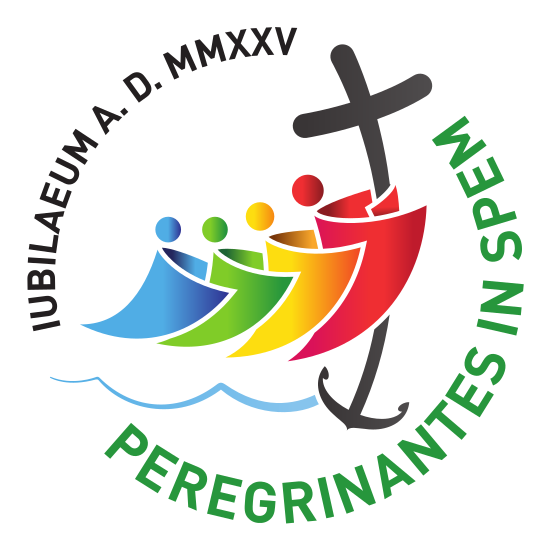
Four stylized figures, symbolizing humanity from the four corners of the earth, embrace each other and together embrace a cross which in turn bends towards humanity to never leave it alone and offering the security of hope.
The lower part of the cross transforms into an anchor, a symbol of hope. Pilgrimage is a community event and not an individual one. The waves moving below symbolize the events of life that are not always calm.
Finally, the Motto of the Jubilee 2025, Peregrinantes in Spem, translated into all languages, is clearly visible in the green colour.
2025 JUBILEE MASCOT
The mascot of the Jubilee 2025 is Luce, a friendly pilgrim, with a yellow k-way, boots dirty with earth, a missionary cross around her neck and a pilgrim’s staff. His eyes shine with an intense light that symbolizes the hope that is born in the heart of every pilgrim.
See all the Jubilee events on the CALENDAR.