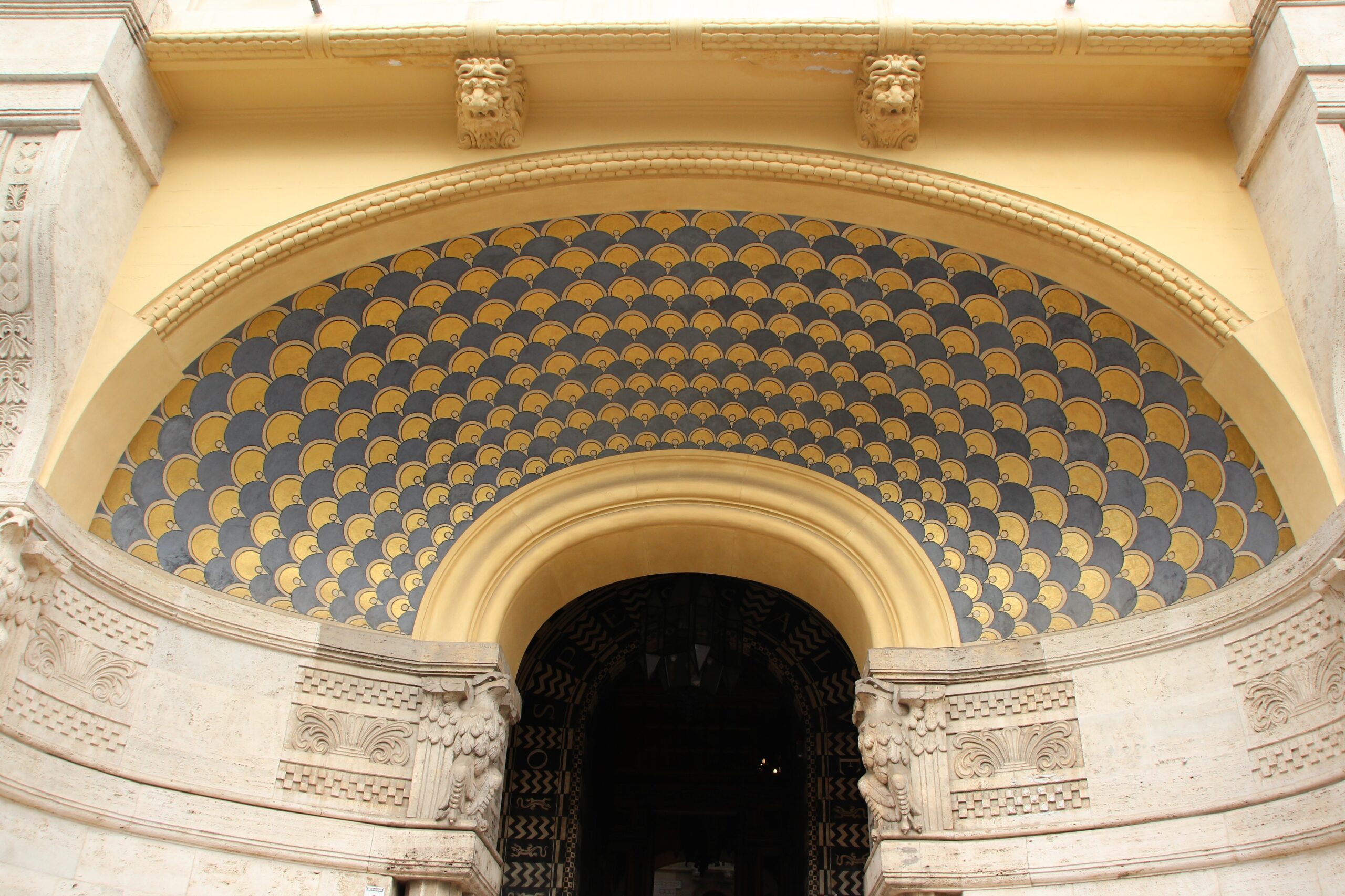
Testaccio Rome is one of Rome’s most authentic neighborhoods. Originally a commercial hub in ancient times and developed as a working-class neighborhood in the late 19th century, today it is a place where history, popular tradition, and contemporary culture meet.
A bit of history
Ancient times: Testaccio was the commercial heart of imperial Rome, with the Emporium (river port) and Monte dei Cocci (Mons Testaceus), an artificial hill created by the accumulation of fragments of amphorae.
Modern age: With the 1873 Master Plan, Testaccio was designated as an industrial and working-class neighborhood. The slaughterhouse and the first workers’ houses were built, profoundly shaping the identity of the neighborhood.
Today:The Testaccio district is a mix of past and present: archaeology, markets, trattorias, contemporary art, and nightlife.
What to see in Testaccio, Rome
What is Monte Testaccio?
Monte dei Cocci, also known as Monte Testaccio, is a unique artificial hill composed of millions of fragments of Roman amphorae used to transport olive oil. Formed between the 1st and 3rd centuries AD, it offers an extraordinary opportunity to explore the history of trade and daily life in ancient Rome.
🏺 Curiosities: What does Testaccio mean?
- Origin of the name: “Testaccio” derives from the Latin mons testaceus, meaning “hill made of shards,” referring to the fragments of amphorae that make up the hill.
- Historical function: Between the 1st and 3rd centuries AD, Monte dei Cocci served as a dumping ground for amphorae used to transport olive oil, mainly from Spain. Once emptied, the amphorae were broken and neatly stacked, creating the artificial hill we see today.
- Disposal techniques: To prevent decomposition and odors, the amphorae were treated with lime during storage.
- Archeological significance: The site offers valuable information on trade and the economy of ancient Rome. Many amphorae bear inscriptions (tituli picti) indicating the origin, contents, and destination of the goods.
- Accessibility: Currently, access to Monte dei Cocci is only permitted to accompanied groups, subject to mandatory booking. You can book your guided tour of Monte dei Cocci with Tour Guide Rome, It will be a unique opportunity to explore this extraordinary archaeological site.
Ex Mattatoio and MACRO Testaccio
The Mattatoio complex, the economic heart of the neighborhood in the 19th century, has now been converted into a cultural space hosting exhibitions, events, and MACRO Testaccio, Rome’s Museum of Contemporary Art. Between industrial pavilions and art installations, the neighborhood shows its most contemporary side. For information on opening hours and exhibitions, please consult the official page.
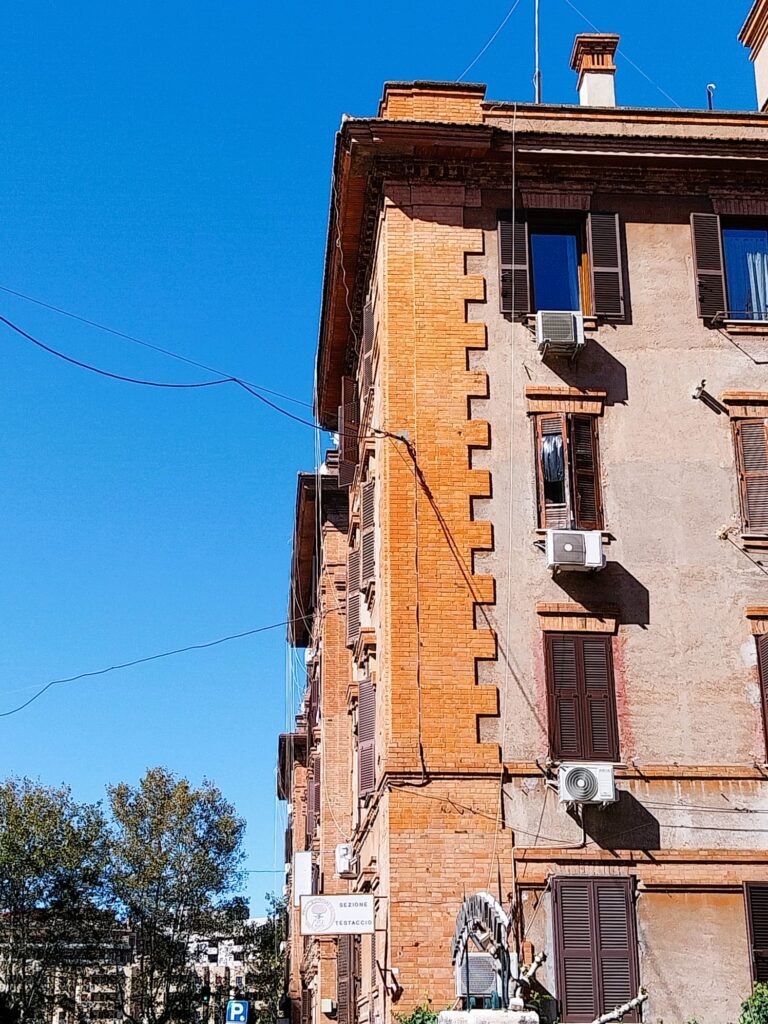
Late 19th-century working-class architecture
At the end of the 19th century, Rome became the capital of the Kingdom of Italy and experienced strong demographic and economic growth. Testaccio was chosen as a model neighborhood for the working class: housing developments were built here according to modern criteria, designed to provide dignity and services to the workers of the slaughterhouse and surrounding industries.
The buildings and architectural style
Closed-block public housing: Built between the late 19th century and the early decades of the 20th century, they are built around large internal courtyards, with loggias, balconies, and common areas. These courtyards were true social hubs, where the daily lives of working-class families intertwined.
Materials and style: Brick masonry prevails, along with a sober, functional style without excessive decoration, but with details typical of the eclectic taste of the period. The buildings retain a compact and uniform character, designed to convey solidity and a sense of community.
Architectural influences: The model is inspired by late 19th-century European working-class cities, but with a “Roman” adaptation that takes into account the climate and outdoor life.
Architects and urban plans
1873 Master Plan: he designed the future of Rome as capital and designated Testaccio as an industrial and working-class district.
Architects: Among the main designers who contributed to the definition of Testaccio were Giovanni Bellucci, author of several public housing blocks, and the technicians of the Istituto Case Popolari (ICP), founded in 1903, which completed the construction of many homes in the neighborhood.
Cottages and terraced houses: Alongside the large public housing blocks, more “garden-style” buildings and small villas were also built, designed for the middle classes, adding architectural variety to the area.
Don’t just visit Testaccio, taste it like a true Roman! Skip the generic food tours and explre Rome’s most auhentic market with a licensed local guide. We will taste real roman street food and family-run specialties at your own pace. Safe and direct booking via Stripe.
Today
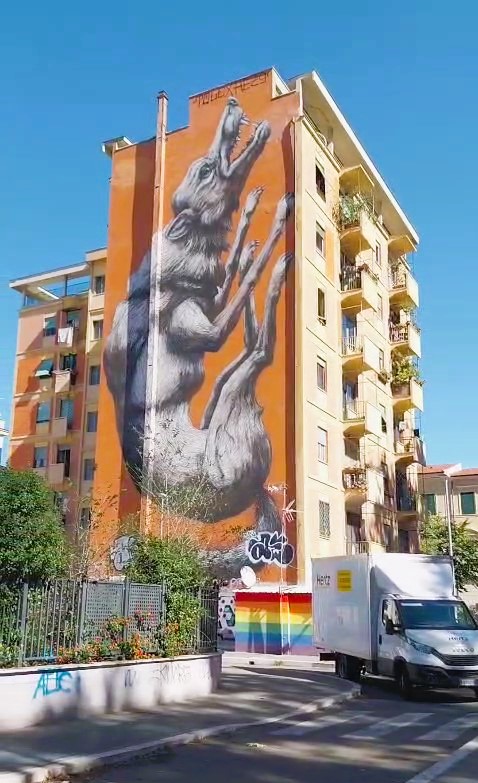
Many of these buildings are still inhabited and maintain the original atmosphere of the neighborhood. Walking between Via Marmorata, Via Galvani, and Piazza Testaccio, you can see the public housing blocks with their internal courtyards, often embellished with murals and contemporary installations, symbols of the cultural transformation of the area.
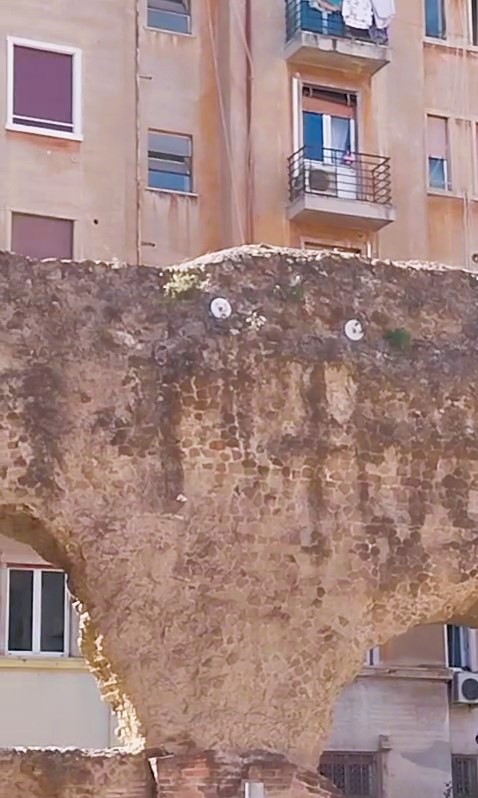
Porticus Aemilia
Impressive remains of a vast warehouse complex dating back to the 2nd century BC, connected to the Emporium, a veritable commercial district for the storage of goods and river port activities. Today, the remains of the Porticus Aemilia are incorporated into the buildings of the popular Testaccio district, bearing witness to its vocation as a commercial and mercantile district since Roman times due to the presence of the Tiber, along which ships sailed to unload their goods.
Piazza Testaccio and the Fountain of the Amphorae
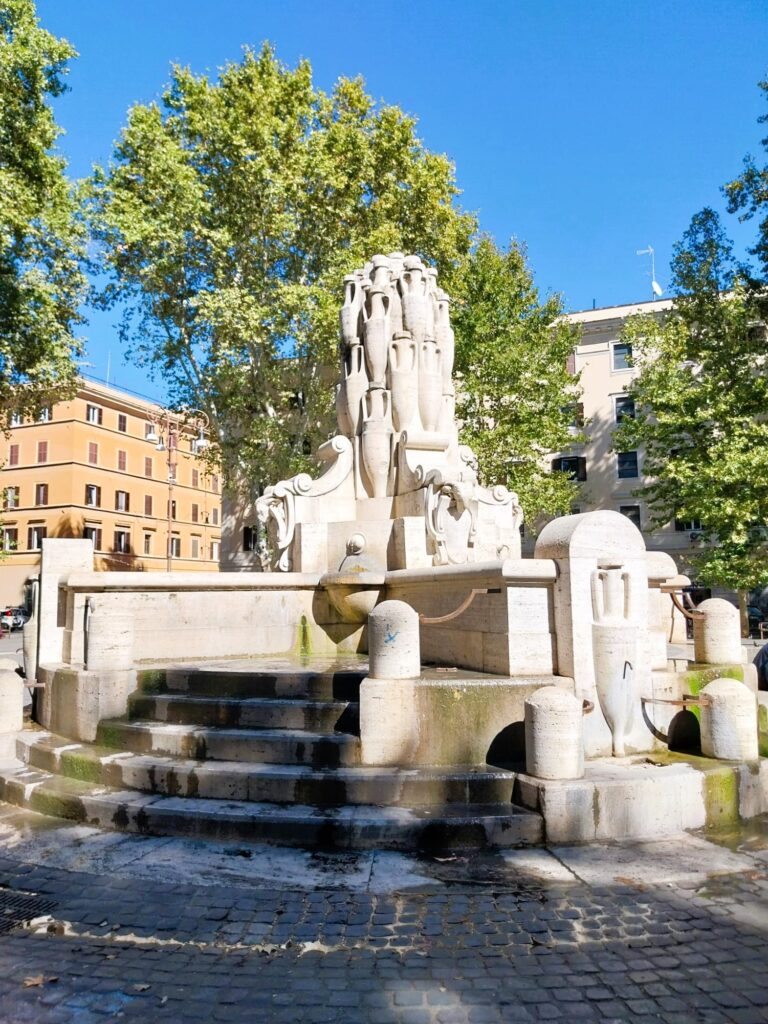
The square has always been the heart of the neighborhood, a place for markets and socializing. The centerpiece is the Fountain of the Amphorae, designed by Pietro Lombardi in 1927.
In the 1930s, it was moved to Piazza dell’Emporio, but in 2012 it returned to its original location, restoring an important part of the neighborhood’s historical memory.
The shape recalls the amphorae of Monte dei Cocci, a symbol of Testaccio’s identity.
💧 Curiosities: Fountain of the Amphorae
- Symbol of Testaccio: designed by Pietro Lombardi in 1927, the fountain echoes the shape of the amphorae piled up on Monte dei Cocci, a historic symbol of the neighborhood.
- A troubled history: In the 1930s, the fountain was moved to Piazza dell’Emporio, temporarily losing its connection with Testaccio. In 2012, thanks to a restoration project, it was returned to its original location, giving the neighborhood back an important part of its identity.
- Social function: in addition to being a decorative element, the fountain was a meeting place for the community, a place for socializing and exchange, in line with the popular vocation of Piazza Testaccio.
- Innovative design: The stylistic language is essential and modern for the period, typical of Lombardi’s work, which combined local symbolism and public functionality in the Roman fountains of the 1920s.
Church of Santa Maria Liberatrice
Built in 1908 at the behest of Pope Pius X, the church was constructed to replace the ancient Santa Maria Liberatrice al Foro Romano, which was demolished to uncover the remains of the early Christian basilica of Santa Maria Antiqua.
- Architect: Gustavo Giovannoni, who designed it in neo-Romanesque style, with a brick façade and central rose window.
- Interior: With three naves, simple decorations, and modern mosaics, it houses a precious Marian icon from the demolished church.
- Social Function:From the outset, it was a spiritual reference point for the inhabitants of the working-class neighborhood, who considered it their “cathedral.”
- Even today, it remains the religious heart of Testaccio and hosts celebrations, events, and community activities.
🏛️ Curiosities: Santa Maria Liberatrice
- From the Roman Forum to Testaccio: The name “Santa Maria Liberatrice” comes from the ancient church that stood in the Roman Forum. It was demolished in 1899 to uncover the remains of the early Christian basilica of Santa Maria Antiqua. In order not to lose the Marian cult, the title was transferred to Testaccio.
- The “workers’ cathedral”:When it was inaugurated in 1908, the church became the religious and social heart of the new working-class neighborhood, hosting not only celebrations but also educational and charitable initiatives.
- A miraculous icon: Inside, it houses the icon of the Madonna Liberatrice, believed to be the protector of families and children. The inhabitants of Testaccio still venerate her with great devotion today.
- Talking architecture:The brick façade and neo-Romanesque style, designed by Gustavo Giovannoni, were chosen to evoke simplicity and solidity, values that reflected the spirit of the working-class neighborhood.
🍝 Food in Testaccio: tradition and must-visit places
Roman cuisine in Testaccio
The Testaccio neighborhood is considered the cradle of traditional Roman cuisine. This is no coincidence: here, next to the slaughterhouse, the culture of the fifth quarter, literally “quinto quarto” developed, namely offal and the less noble parts of the animal, which workers took home as part of their wages. Some of Rome’s most famous recipes were born from this tradition.
Typical dishes you can’t miss
- Coda alla vaccinara 🐂
Oxtail stew with celery, tomato, and unsweetened cocoa powder, cooked slowly until very tender. - Trippa alla romana (roman-style)🍅
Tripe with tomato sauce, mint, and pecorino cheese: a simple dish but rich in flavor. - Rigatoni con la pajata 🍝
Rigatoni with suckling calf intestines, a typical specialty that defines the neighborhood. - Coratella con carciofi 🌿
Sautéed lamb offal with artichokes: a typical Roman holiday dish. - Supplì 🍙
The king of Roman street food, deep-fried, oval-shaped rice croquettes filled with a rich tomato ragù and a molten heart of mozzarella, creating a stringy, “telephone cord” effect (al telefono) when pulled apart. To be enjoyed freshly fried at the Testaccio Market. - Crostata di visciole 🍒
Sour cherry tart, a traditional Jewish-Roman dessert, now also very popular in Testaccio.
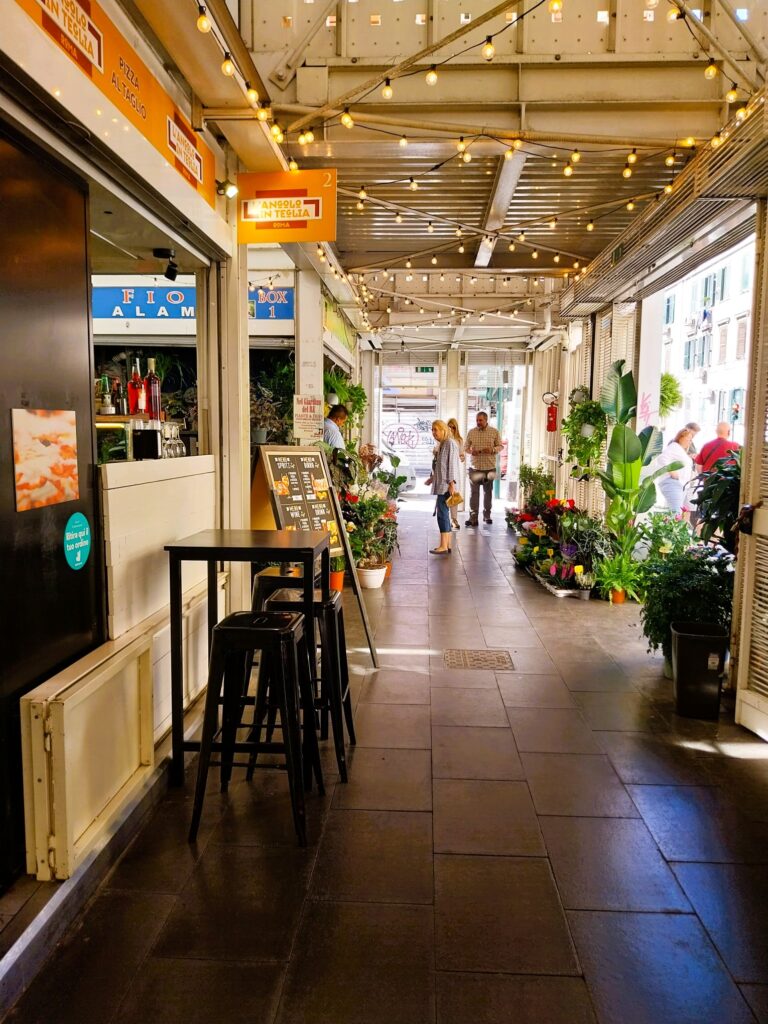
🍷🥘 Gastronomic itinerary in Testaccio
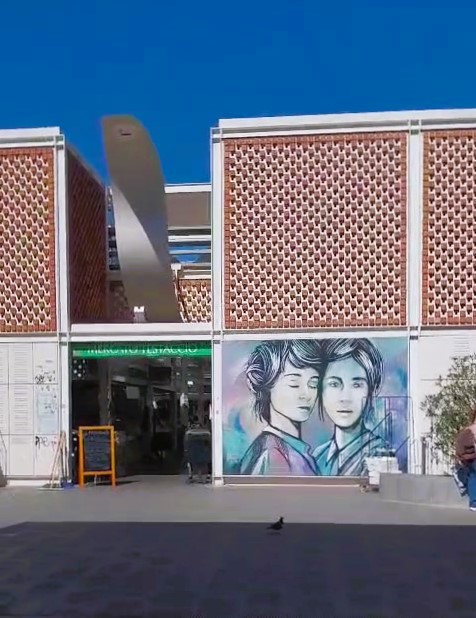
Starting point: Mercato Testaccio (Via Galvani, 54)
Breakfast or sweet snack: Start your day with a coffee and a cornetto (croissant) in one of the market’s cafés.
Street food tasting: Try a freshly fried supplì or a slice of pizza at the historic food stalls.
👉 Authentic atmosphere: here, fruit and vegetable stalls coexist with modern street food shops.
Stage 2: Trapizzino Testaccio (Piazza Testaccio, 4)
An innovative snack rooted in tradition: the Trapizzino, a pocket pizza filled with typical dishes such as pollo alla cacciatora (chicken braised with onions, herbs, tomatoes, wine), polpette al sugo (meatballs in sauce)or coda alla vaccinara (Oxtail stew with celery, tomato, and unsweetened cocoa powder).
Perfect for a quick lunch if you don’t have much time.
Stage 3: Historic restaurant (trattoria)
Choose between two great classics:
- Felice a Testaccio (Via Mastro Giorgio, 29): for the famous cacio e pepe, creamed at the table.
- Checchino dal 1887 (Via di Monte Testaccio, 30): for an authentic “fifth quarter” experience with coda alla vaccinara or trippa alla romana.
👉 Tip: book in advance, especially on weekends.
Stage 4: Sweet ending
Crostata di visciole: A typical Roman dessert with Jewish influences, to be enjoyed in one of the historic pastry shops in the area.
Or some artisanal gelato from “Giolitti Testaccio” (Via Amerigo Vespucci, 35).
Extra (optional with digestif 🍷)
If you still have time and energy, stop at a wine shop or wine bar for a glass of Lazio wine or a Roman amaro.
Perfect area: around Via di Monte Testaccio, where the former caves of Monte dei Cocci are home to characteristic bars and restaurants.
❓ FAQs – Quartiere Testaccio
1. Where is Testaccio located in Rome?
Testaccio is located on the left bank of the Tiber, between the Aventino district and the Ostiense district, south of the historic center.
2. How do you get to Testaccio?
Metro: Line B, Piramide stop.
Train: Ostiense Station.
Bus: Numerous lines connect the neighborhood with Trastevere and the city center.
3. What should you definitely see in Testaccio?
Monte dei Cocci
Ex Mattatoio e MACRO Testaccio
Workers buildings in Via Galvani and Via Marmorata
Piazza Testaccio and Fontana delle Anfore
Church of Santa Maria Liberatrice
Porticus Aemilia
5.How long does the Testaccio walking tour last?
A complete tour lasts about 2-3 hours, including Monte dei Cocci , the ex Mattatoio, workers’ buildings, Piazza Testaccio, the church, and Porticus Aemilia.
6. What are Testaccio’s culinary specialties?
Typical dishes: coda alla vaccinara, trippa alla romana, rigatoni con la pajata
Street food: supplì, pizza by the slice at Mercato Testaccio
Dolci: crostata di visciole
7. Is the area safe for walking?
Yes, Testaccio is a quiet and lively neighborhood. The main streets and squares are well frequented, thanks in part to markets, trattorias, and bars.
8.Is parking available?
There are paid parking spaces along the main roads, but we recommend using public transport, especially when visiting the historic center and pedestrian areas.
9. When is the best time to visit Testaccio?
Spring and fall: mild temperatures and quieter days.
Summer: the neighborhood is lively even in the evening thanks to its nightlife and cultural events.
10. Is it also suitable for children?
Yes, the neighborhood offers peaceful walks, open spaces, and colorful markets. Some cultural venues, such as MACRO Testaccio, also organize activities for families.